
Somatic, Body-Centered Psychotherapy in Missouri & Colorado…
Your body is sensation, posture & movement…the expression of your body reveals your emotions & your thoughts. Psychotherapy is made more complete by addressing the whole experience of your body.
what is Somatic Psychotherapy?
Somatic Psychotherapy is a broad term that can include a number of therapy modalities, movement arts & possibly touch-work that is specific to psychotherapy. Many somatic modalities are still categorized as talk therapy (no touch or movement involved).
A foundational premise that underlies most somatic modalities is that the body is essential in psychological & emotional healing, trauma processing & in shifting relational patterns…in other words, beliefs, thinking & talking are not enough to make a change.
spotlight on the fascia…
Fascia is more than connective tissue…it is the network of interconnection & information moves faster through fascia than the nervous system.
So, why not utilize movement arts & processes for improving interception?
Working with both the nervous system & fascia is a game-changer. I recommend Somatic Groundwork to clients.
spotlight on the nervous system…
Everyone has habits of the nervous system…whether you feel safety in your body or are you running anxiety as if there is an immediate threat? Perhaps you are dissociated or numb much of the time?
To move your nervous system in a new direction takes time, consistency & repetition.
There is no quick fix.

what does Somatic Psychotherapy help with & who is it for?
Somatic Psychotherapy can help with many things, but I think it’s especially valuable for:
dissociation
anxiety & panic
trauma resolution
sensory over-stimulation
sleep disorders
relational patterns
negative through patterns
racing thoughts
feeling stuck
burnout
Processing preverbal issues
Somatic Psychotherapy is suitable for most people, but I think it’s especially valuable for:
Highly-Sensitive People
Empaths
Those who get caught-up in their thoughts
Those who over-think
People who can see the patterns, but can’t change it
Creatives
People who have tried other talk therapy & are ready for something else
People who feel traumatized, but can’t identify a traumatic event
People who are ADHDers
MY SOMATIC PSYCHOTHERAPY MODALITIES
-
Body-Mind Psychotherapy
Body-Mind Psychotherapy is an off-shoot of Bonnie Bainbridge Cohen’s Body-Mind Centering adapted by Susan Aposhyan & continues in the lineage at Naropa University’s Somatic Psychotherapy program.
I utilize both Susan & Bonnie’s approaches with clients to emphasize listening to the body, returning to developmental movement & integrating emotion, attuning emotions & expression.
-
Sensorimotor Psychotherapy
Sensorimotor Psychotherapy was created by Pat Ogden & comes out of the foundational structure of Hakomi.
Sensorimotor Psychotherapy is a talk therapy that works to complete body impulse & movement that is incomplete. This can happen in response to shock trauma & repeated trauma.
I primarily utilize this modality for its approach to assessing postural patterns, orienting patterns & sensory processing.
-
Fundamental Movement & Developmental Somatic Psychotherapy
Developmental Somatic Psychotherapy (Fundamental Movement) is another off-shoot of Bonnie Bainbridge Cohen’s Body-Mind Centering created by Ruella Frank.
Fundamental Movement & DSP emphasize the relational & psychological aspects of our movement….Yield, Push, Reach, Grasp, Pull, Release.
My emphasis with this modality is my own adaptation for how the movements can get stuck or over-emphasized & how to bring them back into balance.
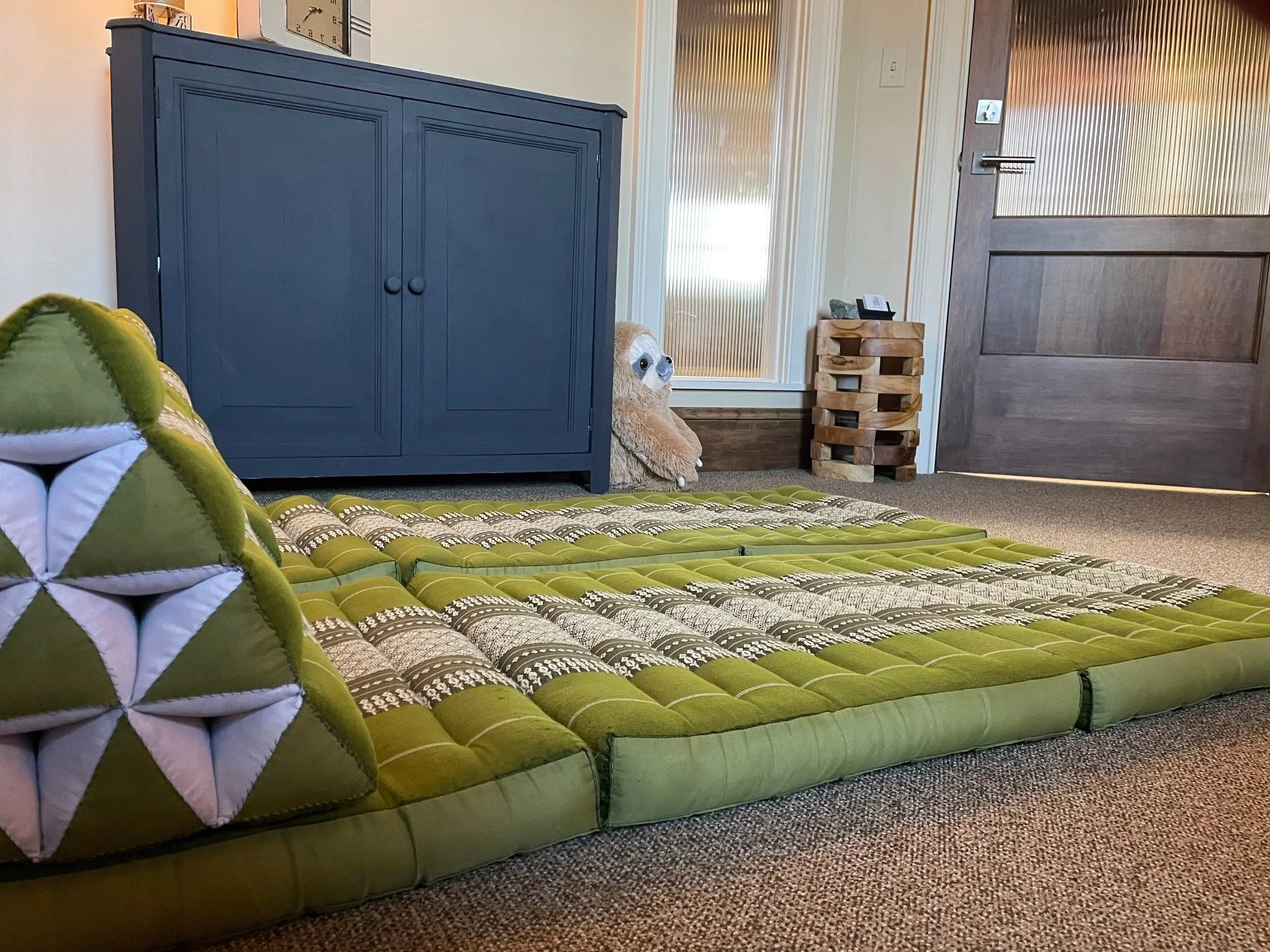
what happens in a somatic psychotherapy session?
I weave Somatic Psychotherapy approaches into sessions as postural & movement experiments as well as using weighted pillows, breath work & an emphasis on tracking how your body responds to your thoughts & new ideas.
For those who want to primarily do Somatic work, we expand into body mapping, robust out-of-session assignments & assessing fundamental movement, relational patterning & more.

“For new experience to be obtained, release of the nervous system control is necessary so that old habits are no longer directing the outcome and new cellular experience can come into being.”
-Bonnie Bainbridge Cohen
Frequently Asked Questions
-
Yes, these terms are usually used interchangeably. There are some distinct definitions with somatic training & terms used in other countries, but when I say Somatic Psychotherapy I would interchange that with Body or Body-Centered Psychotherapy to indicate Multiple Somatic modalities are being used.
-
Yes, Somatic Psychotherapy combined with other therapy modalities is recommended for trauma processing.
In other words, trauma treatment is incomplete without somatic processing.
-
It depends on the therapist.
I do not include touch work even though I am trained in it.
I do use weighted pillows & other props such as mats & yoga balls to serve where touch would be used.
Referrals are given when touch therapies are indicated.
-
There are graduate programs for Somatic & Movement/Dance therapists, but many gain a Master’s degree in Psychotherapy & then continue into other certification programs.
My training is in Sensorimotor Psychotherapy, Body-Mind Psychotherapy & Developmental Somatic Psychotherapy + personal instruction in Tai Chi, Somatic Groundwork, Body-Mind Centering & Somatic Meditation practices.
-
No matter the modality, it is always hard to estimate how long therapy will take…my general answer is to say, real change takes time. Symptom reduction usually takes at least 6 months of regular sessions & efforts outside of session to maintain insights.
For deep processing, it usually takes longer.
-
Yes, in fact I think it’s more effective when combined with other approaches…in therapy would we refer to this as working “bottom up” and “ top down.”
Sometimes we need to fill in the mental and intellectual explanation so the mind can let go…allowing the body, sensations & emotions to come forward.
why is embodiment important?
All change happens in the present moment…real change becomes unattainable if you are not in your body…”in your body” means in the present moment. Otherwise we are on “auto-pilot,” which is fine if you’re simply washing the dishes.
However, even practicing being present while washing the dishes can build capacity for staying present when something much more vital is occurring.
You can’t be embodied by thinking about it, reading about it or talking about it…you must begin with feeling the alive sensations of your body.